



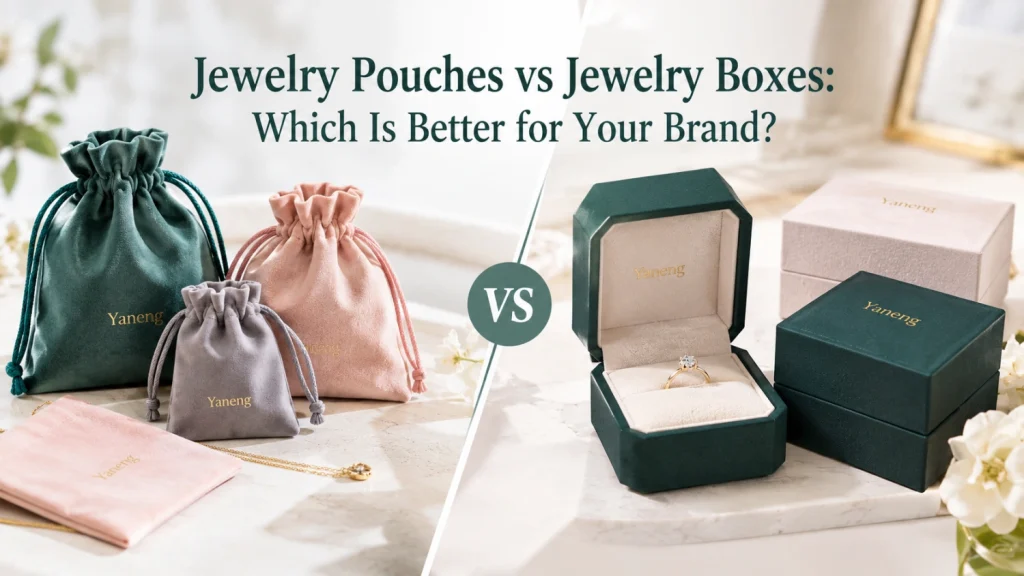
Jewelry Pouches vs Jewelry Boxes: Which Is Better for Your Brand?
Choosing the right packaging is an important decision for jewelry brands, wholesalers, retailers, and distributors. Jewelry packaging protects products during storage and transportation, supports brand identity, and influences how customers perceive the value of their purchases.
Two popular options are jewelry pouches and jewelry boxes. Both can be customized with your logo, colors, and preferred materials, but they serve different purposes.
Jewelry pouches are lightweight, flexible, and convenient for travel or everyday storage. Jewelry boxes provide a more structured presentation and can offer better protection for delicate pieces when designed with suitable inserts.
So, should your business choose jewelry pouches or jewelry boxes?
The answer depends on your jewelry type, target customers, budget, sales channel, and brand positioning. This guide compares the two options to help you make a practical purchasing decision.
1. What Are Jewelry Pouches?
Jewelry pouches are soft bags designed to store, organize, or package jewelry. They are commonly made from velvet, microfiber, satin, cotton, suede-like fabrics, or other textile materials.
They may use drawstrings, zippers, buttons, or simple open-top designs. Different sizes can accommodate rings, earrings, necklaces, bracelets, pendants, and small jewelry sets.
Advantages of Jewelry Pouches
Lightweight and portable
Pouches are easy to carry and take up relatively little storage space. They are suitable for travel jewelry, everyday accessories, promotional gifts, and jewelry sold through online channels.
Flexible packaging options
A pouch can accommodate different jewelry shapes without requiring a rigid box structure. This makes it useful for selected jewelry styles and compact packaging programs.
Lower material and shipping volume
Many pouches require less material and occupy less space than rigid jewelry boxes. Depending on the fabric, design, quantity, and shipping method, they may help reduce packaging and freight costs.
Simple logo customization
Jewelry pouches can support logo printing, embroidery, woven labels, or other branding methods, depending on the material and production process.
Useful for additional protection
A soft pouch can help reduce surface contact, dust exposure, and minor scratches during storage. However, it does not provide the same structural protection against crushing or impact as a suitably designed rigid box.
Limitations of Jewelry Pouches
Pouches are not ideal for every jewelry product.
- They offer limited protection against crushing and strong impacts.
- Chains may tangle if the pouch lacks compartments or dedicated holders.
- Soft fabric may not maintain a premium display shape on its own.
- Some materials can collect dust, lint, or moisture if stored improperly.
- Delicate stones and fragile settings may require additional protection.
For jewelry that needs a more formal presentation or stronger structural support, a jewelry box may be the better choice.
2. What Are Jewelry Boxes?
Jewelry boxes are structured containers designed to protect, store, display, or present jewelry. They can be made from paperboard, wood, PU leather, plastic, velvet-covered materials, or combinations of different materials.
Common styles include lid-and-base boxes, drawer boxes, magnetic boxes, flip-top boxes, folding boxes, and boxes with custom inserts.
Advantages of Jewelry Boxes
More structured protection
A rigid or reinforced box can help protect jewelry from pressure and accidental handling. Custom inserts can hold rings, earrings, necklaces, and bracelets in position.
The level of protection depends on the box structure, material thickness, insert design, and overall construction.
Premium product presentation
A well-designed jewelry box creates a defined space for the jewelry. It can help reinforce a luxury, classic, minimalist, or contemporary brand image.
Better organization
Custom inserts, dividers, necklace hooks, ring slots, and compartments can keep jewelry organized and reduce movement inside the packaging.
More branding opportunities
Jewelry boxes can incorporate foil stamping, embossing, debossing, printed graphics, custom colors, textured materials, ribbons, and other finishing details.
Suitable for retail and gifting
Boxes are commonly used for engagement rings, fine jewelry, anniversary gifts, premium collections, and coordinated jewelry sets. They can also be designed to match a brand’s wider packaging range.
Limitations of Jewelry Boxes
Although jewelry boxes offer several advantages, they also have some considerations.
- Rigid boxes generally take up more storage space than pouches.
- Larger dimensions and heavier materials may increase freight costs.
- Premium materials and complex structures can increase unit prices.
- Custom boxes may require sampling and additional production time.
- Poorly designed inserts can allow jewelry to move or become tangled.
For businesses with high sales volumes, comparing different box structures and packaging specifications can help balance presentation, protection, and cost.
3. Jewelry Pouches vs Jewelry Boxes: Key Differences
The main difference is that pouches prioritize flexibility and portability, while boxes prioritize structure and presentation.
Protection
Jewelry boxes generally provide better protection against crushing when they have a suitable rigid structure and properly fitted inserts.
Pouches can help protect jewelry surfaces from minor scratches, but they offer limited protection against pressure or impact. They are often best used for lightweight jewelry, travel storage, or as an additional layer inside another package.
Cost
Jewelry pouches may have a lower unit cost, especially for simple designs and suitable order quantities. Their compact shape can also reduce storage and shipping volume.
Jewelry boxes vary widely in price. A basic paper box may be economical, while a rigid box with a custom insert, premium covering material, and foil-stamped logo will usually require a larger budget.
Compare the complete cost, including customization, packing, shipping, and any applicable import charges, rather than comparing unit prices alone.
Branding
Both options support branding.
Pouches are useful for subtle logos, fabric textures, and understated packaging. Boxes offer a larger, more structured surface for branded graphics, premium finishes, and coordinated designs.
The better option depends on your brand identity and how customers receive the product.
Storage and Shipping
Pouches are flexible and often easier to store in bulk. They can be packed flat or folded depending on the design.
Rigid jewelry boxes generally need more storage space. Folding boxes can be a useful alternative when a brand wants a box-style presentation but also needs to reduce storage volume.
Customer Experience
A pouch can create a casual, practical, or travel-friendly experience.
A jewelry box can create a more formal unboxing experience, especially for gifts, engagement rings, or premium retail products.
Neither option automatically makes a product feel more valuable. Material quality, design consistency, product presentation, and brand expectations all influence the final impression.
4. Which Jewelry Packaging Is Better for Different Products?
The best packaging depends on the type of jewelry you sell and how it will be used.
Ring Packaging
For engagement rings, fine rings, and gift-oriented collections, a ring box with a fitted insert is often the more suitable choice. It keeps the ring in a defined position and provides a clear presentation.
A small jewelry pouch can work well for fashion rings, simple accessories, or travel packaging. It may also be included alongside a box as an additional storage option.
Necklace Packaging
Necklaces can tangle easily, particularly when chains are fine or long.
A necklace box with a dedicated insert, hook, or chain holder can help keep the product organized. A pouch is also useful, but a simple open pouch may allow chains to knot together.
For wholesale buyers, the best solution may be a pouch with a suitable internal holder or a box designed specifically for necklaces.
Earring Packaging
Small earrings can be packaged in either pouches or boxes.
A jewelry box with an earring card or fitted insert can keep pairs together and improve display. Pouches may be appropriate for lightweight fashion earrings, replacement packaging, or promotional products.
Bracelet Packaging
Bracelets, bangles, and cuffs vary in size and shape.
A box with a custom insert can support the bracelet and help maintain its presentation. A pouch may be sufficient for flexible bracelets or products intended for travel, but rigid bangles may need additional protection.
Jewelry Sets
For matching necklaces, earrings, rings, or bracelets sold together, a jewelry box set can provide coordinated compartments and a consistent presentation.
Pouches can complement the set by offering separate storage for individual pieces. This combination is especially useful when customers need to store or travel with the jewelry after purchase.
5. Which Option Is Better for Luxury Jewelry Brands?
Luxury packaging should reflect the product’s positioning while meeting practical requirements for protection, usability, and cost.
Jewelry boxes are often selected for luxury collections because they offer structured presentation, custom inserts, and a wide range of surface finishes. Materials such as velvet, PU leather, textured paper, and microfiber can support different visual styles.
However, a pouch can also be an effective part of a luxury packaging program.
A velvet or microfiber pouch with a carefully finished logo may suit minimalist jewelry, premium everyday accessories, or travel collections. It can also be used inside a jewelry box to create an additional layer of packaging.
For luxury brands, consider these questions:
- Does the packaging match the product’s price point?
- Does it protect the jewelry during storage and transportation?
- Does the material reflect the brand’s visual identity?
- Can the packaging be customized consistently across product categories?
- Is the packaging practical for the customer’s everyday use?
- Does the total packaging cost fit the product’s profit margin?
A coordinated packaging system may deliver more value than choosing only one format.
For example, a brand could use a rigid ring box for presentation and a branded velvet pouch for ongoing storage. The additional component increases packaging cost, so it should be included only when it supports the product strategy and customer experience.
6. Which Option Is Better for Wholesale Buyers?
Wholesale buyers need to consider more than product appearance. Packaging cost, order quantity, storage, repeat purchasing, and product consistency all affect sourcing decisions.
When to Choose Wholesale Jewelry Pouches
Pouches may be a good option if your business:
- Sells lightweight fashion jewelry or everyday accessories
- Needs compact packaging for travel products
- Prioritizes low shipping volume
- Wants simple branded packaging for promotions
- Needs pouches to accompany existing jewelry boxes
- Purchases packaging in quantities that support competitive pricing
When sourcing wholesale jewelry pouches, compare fabric thickness, stitching quality, drawstring or zipper performance, logo finish, available sizes, and color consistency.
When to Choose Wholesale Jewelry Boxes
Boxes may be more appropriate if your business:
- Sells fine jewelry or gift-oriented collections
- Requires a structured presentation
- Needs inserts for rings, necklaces, earrings, or bracelets
- Wants premium retail packaging with a custom logo
- Plans to build a coordinated packaging collection
- Needs packaging designed around specific product dimensions
When sourcing wholesale jewelry boxes, compare material, structural strength, insert fit, surface finishing, logo placement, sample quality, and production lead time.
How MOQ Affects Your Decision
Minimum order quantity varies by supplier and product.
Stock pouches or boxes may be available in smaller quantities, while custom colors, special materials, unique structures, or new inserts can require higher MOQs.
Ask suppliers to quote several quantities where practical. This helps you understand whether a larger order creates meaningful savings and whether the additional inventory is manageable.
For a new product launch, a stock option or a simpler custom design may reduce initial risk. For established products with predictable sales, a larger customized order may provide better long-term value.
7. Can Jewelry Brands Use Both Pouches and Boxes?
Yes. Combining jewelry pouches and jewelry boxes can provide flexibility without forcing every product into the same packaging format.
A business could use:
- A branded ring box for engagement rings and premium rings
- A necklace box with a chain holder for delicate necklaces
- A small pouch for fashion jewelry and travel products
- A jewelry box set for coordinated collections
- A branded pouch inside selected jewelry boxes
- A reusable pouch for customers who need convenient storage
This approach allows packaging to match the product rather than applying a single solution to every item.
However, using both formats increases the number of products that need to be purchased, stored, and managed. Buyers should consider whether the additional packaging improves the customer experience enough to justify the extra cost.
A practical starting point is to group your jewelry into categories by value, fragility, size, and sales channel. Then select the most suitable packaging for each category.
8. How to Choose the Right Jewelry Packaging Supplier
Whether you choose pouches, boxes, or both, the supplier plays an important role in the final result.
Check Product Quality
Request physical samples whenever possible. For pouches, inspect stitching, fabric feel, dimensions, closure performance, and logo quality.
For boxes, inspect structure, insert fit, corners, hinges, magnets, surface finishing, and logo alignment.
Confirm Customization Capabilities
If you need branded packaging, confirm which logo methods and materials are available. Ask whether the supplier can match colors and coordinate designs across different product categories.
Compare MOQ and Total Cost
Request quotations based on the same specifications and quantities. Confirm whether sampling, tooling, logo setup, packaging, freight, and other charges are included.
Confirm Production and Delivery Time
Ask for separate estimates for sampling, mass production, and shipping. Allow time for sample approval, particularly when packaging needs to match a specific jewelry collection.
Review Quality Control and After-Sales Support
Ask how the supplier checks finished products, handles defects, and manages repeat orders. For large or customized orders, agree on written specifications and an approved sample before production.
A supplier that can support both jewelry pouches and jewelry boxes may also help simplify sourcing and coordinate the look of your packaging collection.
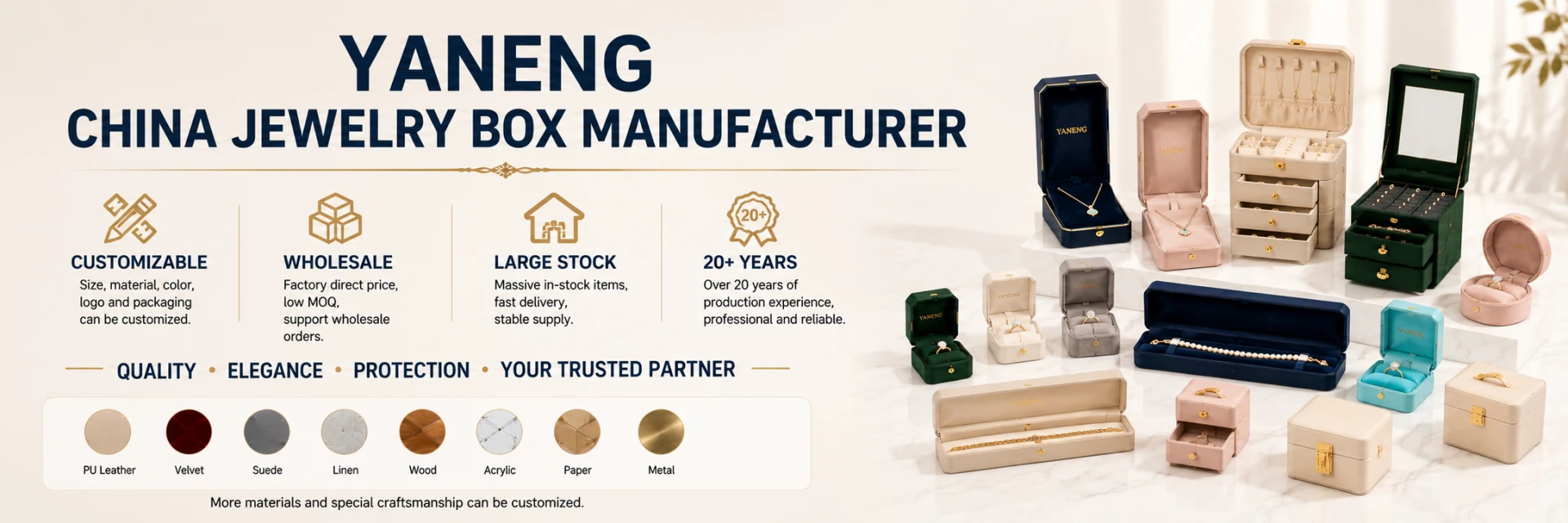
9. Why Consider Yaneng for Jewelry Pouches and Jewelry Boxes?
Yaneng Jewelry Box Manufacturer is a B2B packaging supplier serving jewelry brands, wholesalers, distributors, importers, and retailers.
Guangzhou Yaneng Packing Co., Ltd. was established in 2005. The company offers jewelry packaging products and supports OEM, ODM, wholesale, and customization projects.
Its product range includes:
- Velvet and microfiber jewelry pouches
- Ring, necklace, earring, and bracelet boxes
- Velvet and PU leather jewelry boxes
- Custom jewelry box sets
- Jewelry display trays and stands
- Paper gift bags and other complementary packaging products
For buyers sourcing both pouches and boxes, a broader product range can make it easier to discuss coordinated colors, logos, packaging specifications, and purchasing schedules.
Depending on your project, you can discuss available materials, logo methods, sizes, inserts, sample development, MOQ, production time, and shipping arrangements with the Yaneng team.
Before placing a mass-production order, confirm the product specifications and approve a sample that matches your requirements.
Learn more about the available options at Yaneng Jewelry Packaging Manufacturer.
10. Get a Quote for Custom Jewelry Pouches or Jewelry Boxes
If you are a jewelry brand, wholesaler, distributor, importer, or retailer, choosing the right packaging starts with understanding your products and purchasing requirements.
To receive a more accurate quotation, prepare the following details:
- Product type: Jewelry pouch, ring box, necklace box, earring box, bracelet box, or jewelry box set
- Dimensions: Required size and internal space
- Material: Velvet, microfiber, PU leather, paper, or another preferred material
- Logo: Artwork and preferred printing, embroidery, or stamping method
- Quantity: Estimated order volume and repeat-order plans
- Design references: Photos, sketches, or existing packaging samples
- Target market: Country or region where the products will be sold
- Delivery requirements: Destination and expected arrival date
With this information, a supplier can recommend suitable materials and structures and explain the differences in price, MOQ, and lead time.
Looking for custom jewelry pouches or wholesale jewelry boxes?
Contact Yaneng to discuss your packaging project, explore customization options, and request a quotation for your business.
Conclusion
Jewelry pouches and jewelry boxes serve different packaging needs.
Pouches are lightweight, portable, and useful for everyday storage, travel jewelry, and cost-conscious packaging programs. Jewelry boxes provide more structure, support custom inserts, and are often suitable for gift presentation, fine jewelry, and coordinated retail collections.
For many jewelry businesses, the best solution is not choosing one format for every product. It is matching the packaging to the jewelry type, brand positioning, customer experience, and total budget.
Before placing a wholesale order, compare samples, material quality, MOQ, customization options, production schedules, and total landed costs. A suitable packaging supplier can help you create a consistent brand experience while keeping purchasing and inventory requirements manageable.