

How a Jewelry Box Factory Develops Custom Designs for Jewelry Brands
Custom jewelry packaging is more than a container for rings, necklaces, earrings, and bracelets. It is part of a jewelry brand’s identity. The right jewelry box can improve product presentation, protect valuable items, and create a memorable customer experience.
For jewelry brands, wholesalers, and retailers, developing custom jewelry boxes requires more than choosing a color and printing a logo. It involves understanding the brand’s positioning, selecting suitable materials, designing the internal structure, creating samples, and preparing the product for consistent bulk manufacturing.
A professional jewelry box factory plays an important role throughout this process. It helps transform a brand’s ideas into practical packaging products that can be manufactured at the required quality, quantity, and cost.
In this guide, we explain how a jewelry box factory develops custom designs for jewelry brands, from the first discussion to sample approval and mass production.
1. Understanding the Jewelry Brand and Its Packaging Requirements
Every custom jewelry box project begins with understanding the customer’s business and packaging goals.
Different jewelry brands have different product styles, customer groups, and market positions. A packaging design suitable for an affordable fashion jewelry brand may not be appropriate for a luxury jewelry collection.
Before developing a design, the factory needs to understand several important details.
Brand Positioning
The first step is to identify the brand’s market positioning.
For example:
- Luxury jewelry brands may prefer premium materials, elegant structures, and refined logo finishing.
- Fashion jewelry brands may focus on attractive colors, modern designs, and cost-effective packaging.
- Wholesale jewelry distributors may need standardized box styles in multiple sizes.
- Online jewelry sellers may prioritize lightweight packaging and product protection during delivery.
- Retail jewelry stores may require coordinated packaging for different jewelry categories.
Understanding the target market helps the design team recommend suitable packaging solutions.
Jewelry Product Types
The type of jewelry also affects the box design.
A jewelry box factory needs to know whether the packaging is intended for:
- Rings
- Earrings
- Necklaces
- Bracelets
- Bangles
- Pendants
- Jewelry sets
Each product requires a different internal structure.
For example, a ring box needs a secure ring slot, while a necklace box may require hooks or a specially designed insert to prevent the chain from becoming tangled.
Target Budget and Order Quantity
Budget and order quantity should be discussed early.
Some brands need premium custom packaging for a limited collection, while others require thousands of boxes for regular wholesale orders.
The factory can then recommend a suitable balance between material quality, structural complexity, customization, and production cost.
2. Developing the Initial Design Concept
After understanding the brand requirements, the design team begins developing the initial packaging concept.
This stage turns general ideas into a visual direction for the custom jewelry box.
Reviewing Brand References
Buyers may provide:
- Brand logos
- Brand color guidelines
- Existing packaging
- Product photographs
- Reference designs
- Competitor packaging examples
- Inspiration images
These materials help the design team understand the desired appearance.
If a brand already has a packaging style, the factory can develop new designs that maintain consistency with its existing products.
If the brand is creating packaging for the first time, the design team can suggest different styles based on its target customers and budget.
Selecting the Visual Style
Common jewelry box design directions include:
Minimalist Design
Simple shapes, clean colors, and subtle logo placement create a modern appearance. This style is suitable for many contemporary jewelry brands.
Luxury Design
Velvet surfaces, premium paper, metallic logos, and carefully finished structures can create a more sophisticated presentation.
Classic Design
Traditional colors, elegant textures, and timeless box structures work well for brands that want a consistent and recognizable packaging style.
Modern Colorful Design
Bright colors, customized patterns, and creative combinations can help fashion jewelry brands create a distinctive identity.
The design should reflect the brand rather than simply follow short-term packaging trends.
3. Choosing the Right Jewelry Box Structure
The structure determines how a jewelry box opens, closes, stores the product, and presents it to customers.
A jewelry box factory evaluates the product dimensions, intended use, and brand requirements before recommending a structure.
Lid and Base Jewelry Boxes
These boxes have a separate top and bottom section. They offer a classic appearance and are suitable for ring boxes, necklace boxes, earring boxes, and jewelry gift sets.
Drawer Jewelry Boxes
Drawer boxes use a sliding inner tray and an outer sleeve. They provide a different opening experience and can be customized with ribbons, handles, or printed details.
Flip-Top Jewelry Boxes
Flip-top boxes have an attached lid that opens from one side. They are convenient for retail display and can be designed with different interior inserts.
Magnetic Jewelry Boxes
Magnetic boxes use concealed magnets to keep the lid closed. They are suitable for brands looking for a modern presentation and a secure closing mechanism.
Foldable Jewelry Boxes
Foldable structures can reduce storage and transportation space. They are worth considering for brands that need to manage logistics costs while maintaining a rigid-box appearance.
The best structure depends on the product, desired customer experience, packaging budget, and production requirements.
4. Selecting Materials, Colors, and Surface Finishes
Material selection is one of the most important parts of custom jewelry box development.
The materials affect appearance, touch, durability, weight, and manufacturing cost.
Velvet Jewelry Boxes
Velvet is widely used for jewelry packaging because of its soft texture and elegant appearance.
It is suitable for ring boxes, necklace boxes, earring boxes, and premium jewelry collections.
Popular colors include black, red, blue, green, pink, and other customized shades.
PU Leather Jewelry Boxes
PU leather offers a smooth surface and a leather-like appearance.
It can be used for luxury-style jewelry boxes and customized sets. Different textures and colors allow brands to create distinctive packaging.
Paper Jewelry Boxes
Paper jewelry boxes offer flexible printing and customization options.
Brands can choose different paper colors, textures, patterns, and logo finishes to match their visual identity.
Wood and Other Materials
Wooden jewelry boxes can create a more traditional or premium appearance. Depending on the design, manufacturers may also work with microfiber, plastic, metal components, and combinations of different materials.
Custom Colors and Finishing
The design team also considers how the materials and colors work together.
Possible finishing options include:
- Hot foil stamping
- Embossed logos
- Debossed logos
- Screen printing
- UV coating
- Matte or gloss finishes
- Customized interior lining
For brand consistency, buyers should provide color references and logo artwork before sample development.
5. Designing the Interior Structure for Different Jewelry Products
A jewelry box should present the product attractively while keeping it securely in place.
The interior design must match the actual jewelry dimensions and shape.
Ring Box Inserts
Ring inserts usually include specially shaped slots to hold one or more rings.
The insert material should support the ring without making it difficult to remove.
Necklace Box Inserts
Necklace boxes may require hooks, slots, or specially designed inserts to keep chains organized.
The design should reduce movement and help prevent tangling during storage and transportation.
Earring Box Inserts
Earring inserts need suitable holes or holders to keep earrings positioned correctly.
The insert should match the earring style and size.
Bracelet and Bangle Inserts
Bracelet boxes may use padded cushions or shaped inserts to support the jewelry.
The dimensions should allow the item to sit securely without excessive pressure.
Jewelry Set Inserts
For brands selling matching jewelry sets, a single box may contain several compartments.
The factory can develop a coordinated insert for rings, earrings, necklaces, and bracelets.
Whenever possible, buyers should provide actual jewelry samples or accurate product dimensions. This helps the factory design inserts that fit the products correctly.
6. Creating Technical Drawings and 3D Design Previews
After the structure, materials, and interior have been discussed, the design team prepares the technical details.
This stage connects the visual concept with the actual manufacturing process.
Technical Drawings
Technical drawings help define:
- External box dimensions
- Internal dimensions
- Board thickness
- Lid and base construction
- Opening direction
- Insert measurements
- Logo position
- Material specifications
- Assembly details
These details help the production team understand how the box should be manufactured.
3D Design Previews
For projects that involve customized shapes or multiple components, a 3D preview can help buyers understand the proposed appearance.
It allows the brand to review the overall proportions, colors, structure, and logo placement before physical sample production.
However, a digital preview cannot fully replace a physical sample. Material texture, actual color, structural strength, and opening performance still need to be checked on a real product.
7. Developing Physical Samples
Once the design is confirmed, the factory moves to sample development.
A physical sample allows the buyer to evaluate whether the design works as expected.
Sample Production
The sample is produced according to the agreed specifications as closely as possible.
It may include the selected materials, box structure, logo finishing, and interior insert.
For more complex designs, additional adjustments may be necessary before the final sample is approved.
Sample Evaluation
Buyers should inspect several important details:
- Box dimensions
- Material quality
- Color accuracy
- Logo position
- Printing quality
- Corner finishing
- Lid or drawer movement
- Insert fit
- Product protection
- Overall appearance
If the sample does not meet expectations, the buyer should provide clear feedback.
For example, instead of saying that the box looks different, explain whether the color is too dark, the logo is too large, or the insert is too loose.
Clear feedback helps the factory make more accurate adjustments.
Sample Approval
After any necessary revisions, the buyer confirms the final sample.
The approved sample becomes an important reference for mass production.
Both parties should also confirm the material specifications, dimensions, logo details, and any agreed changes in writing.
8. Adjusting the Design for Mass Production
A design that looks good as a sample is not automatically suitable for large-scale production.
Before bulk manufacturing, the factory needs to consider production efficiency, material availability, assembly requirements, and quality consistency.
Reviewing Structural Feasibility
The factory checks whether the approved design can be manufactured consistently.
Some structures may require adjustments to improve assembly or reduce the risk of defects.
Any changes that affect appearance, dimensions, or functionality should be discussed with the buyer before implementation.
Controlling Material Consistency
The manufacturer needs to confirm the materials used for bulk production.
Changes in paper texture, velvet color, board thickness, or accessories may affect the finished product.
For important brand projects, buyers should confirm the approved material references before production begins.
Planning Production Efficiency
The factory evaluates the production steps, required equipment, assembly process, and expected order quantity.
A design that is easier to manufacture consistently may help reduce production difficulties and improve delivery planning.
The objective is not to remove the brand’s customization requirements. It is to make sure the design can be produced reliably at the required scale.
9. Quality Control During Custom Jewelry Box Production
Quality control is essential when developing custom jewelry boxes for brands.
A professional manufacturer should check quality throughout the production process rather than relying only on final inspection.
Material Inspection
Incoming materials should be checked against the confirmed specifications.
This includes board thickness, paper quality, fabric color, accessories, and other important components.
Printing and Logo Inspection
The production team checks printing quality, logo position, color consistency, and finishing details.
Structural Inspection
Inspectors check the dimensions, shape, corners, and overall stability of the boxes.
Functional Inspection
Boxes with magnets, drawers, hinges, or other moving components should be tested to confirm that they work properly.
Final Inspection
Finished products are checked for visible defects, incorrect assembly, surface damage, and other issues before packing.
For brands that place repeat orders, consistent inspection standards help maintain a recognizable packaging appearance across different production batches.
10. How Long Does Custom Jewelry Box Design Development Take?
The development timeline depends on the complexity of the design, materials, sample requirements, and communication speed.
A typical project includes the following stages:
- Requirement discussion and design briefing.
- Structure and material selection.
- Technical drawing and artwork confirmation.
- Physical sample production.
- Sample review and adjustment.
- Final sample approval.
- Mass production planning.
For many projects, sample development may take approximately 5–7 days after the design and materials are confirmed.
Mass production may take around 15 days for some standard projects, depending on order quantity, structure, material availability, and factory schedule.
Complex designs, special materials, multiple revisions, and large quantities may require more time.
Buyers should confirm the actual schedule with the manufacturer before placing an order.
11. What Information Should Jewelry Brands Prepare Before Requesting a Custom Design?
Providing complete information helps the factory develop a more accurate design and quotation.
Before contacting a jewelry box manufacturer, prepare the following details.
Brand information
- Brand name and logo
- Brand positioning
- Target customer group
- Preferred packaging style
- Brand color references
Product information
- Jewelry type
- Product dimensions
- Product weight
- Actual product photographs
- Whether the product needs an insert or additional protection
Packaging requirements
- Preferred box structure
- Box dimensions
- Material preferences
- Interior lining requirements
- Logo and printing methods
- Special finishing requirements
Order information
- Estimated order quantity
- Target unit budget
- Destination country
- Required delivery date
- Individual packing requirements
Design references
- Existing packaging samples
- Reference photographs
- Design drawings
- Competitor packaging examples
If some details are not available, buyers can begin with product photographs, approximate dimensions, and a description of their desired packaging style.
An experienced design team can help evaluate the initial requirements and recommend suitable options.
12. How to Choose a Jewelry Box Factory for Custom Design Projects
Not every packaging supplier has the same design and manufacturing capabilities.
When selecting a jewelry box factory, brands should evaluate more than the sample appearance.
Check Factory Experience
Look for a manufacturer with experience in jewelry packaging and different box structures.
Ask for examples of previous projects and the types of products the factory can produce.
Evaluate Design Support
A capable supplier should be able to discuss structure, materials, inserts, printing, and manufacturing feasibility.
The team should also explain possible limitations instead of simply accepting every design request.
Review Sampling Capabilities
Ask how samples are developed, how revisions are handled, and whether the sample uses the same materials intended for bulk production.
Understand Manufacturing Capacity
For wholesale orders and long-term cooperation, confirm that the factory can support your expected quantities and production schedule.
Check Quality Control Procedures
Ask how materials, semi-finished products, and completed jewelry boxes are inspected.
A clear quality control process is important for maintaining consistent results.
Compare Complete Quotations
Compare quotations based on the same specifications.
Consider materials, dimensions, structure, logo finishing, inserts, MOQ, sample charges, packaging, and delivery terms.
The lowest price is not always the best choice if it comes with compromises in quality or production support.
13. Custom Jewelry Box Design and Manufacturing at Yaneng Packaging
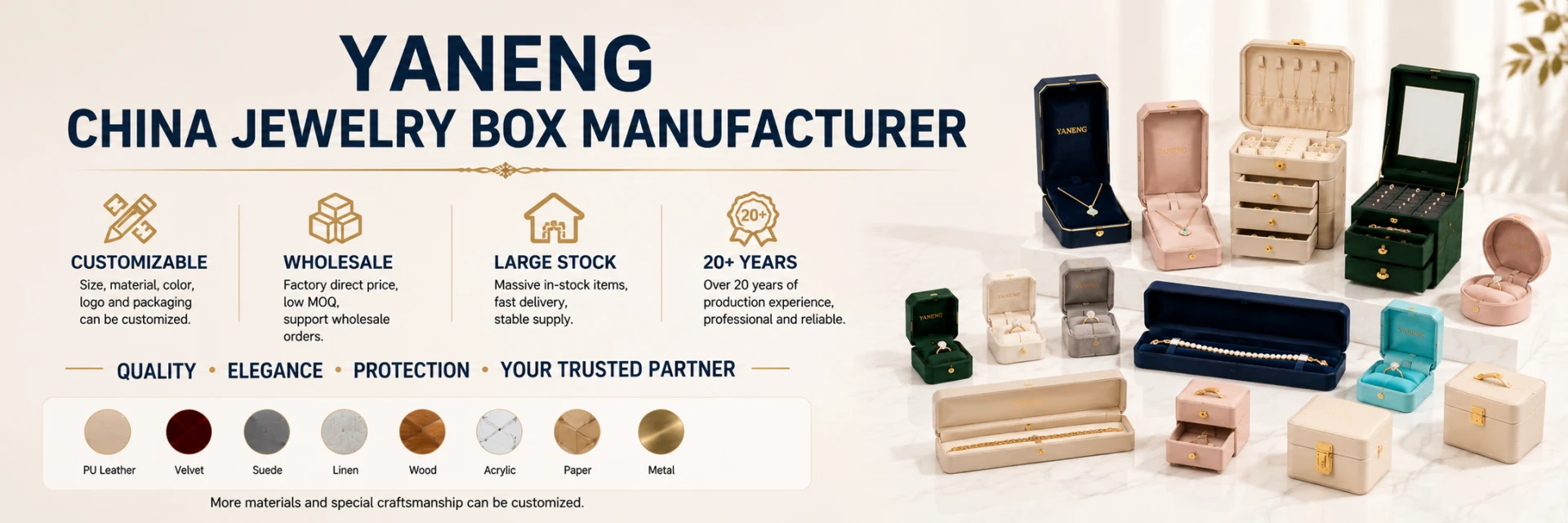
Guangzhou Yaneng Pacagking Co., Ltd. is a China-based packaging manufacturer established in 2005. With approximately 5,000 square meters of factory space in Panyu, Guangzhou, and a production facility in Yiwu, Yaneng provides customized packaging solutions for jewelry brands, wholesalers, trading companies, and retailers.
Our product range includes:
- Ring boxes
- Necklace boxes
- Earring boxes
- Bracelet and bangle boxes
- Jewelry box sets
- Velvet jewelry boxes
- PU leather jewelry boxes
- Paper jewelry boxes
- LED jewelry boxes
- Jewelry display trays and accessories
For custom jewelry box projects, Yaneng supports buyers from the initial design discussion to sample development and bulk production.
Our team can help customers evaluate box structures, select materials, develop interior inserts, arrange logo customization, and prepare designs according to their product requirements.
With more than 20 years of packaging experience, we understand that jewelry brands need packaging that combines product protection, brand presentation, practical manufacturing, and consistent quality.
We support OEM, ODM, wholesale, and customized packaging projects. Sample arrangements, minimum order quantities, production schedules, and pricing are confirmed according to the selected design and order requirements.
Whether you are developing a new jewelry collection or updating existing packaging, Yaneng can help you explore suitable custom jewelry box solutions.
Conclusion
Developing custom jewelry boxes for a brand involves several important stages, including understanding brand requirements, creating design concepts, selecting structures and materials, developing inserts, preparing technical drawings, producing samples, and planning mass manufacturing.
A professional jewelry box factory does more than turn a logo into a printed box. It helps ensure that the packaging reflects the brand identity, fits the jewelry correctly, and can be manufactured consistently for wholesale orders.
For jewelry brands, providing clear specifications and reviewing physical samples before bulk production are essential steps.
Looking for a jewelry box factory to develop custom packaging for your brand? Contact Yaneng Packaging with your jewelry product details, design references, logo artwork, and estimated order quantity. Our team can help you evaluate the design and discuss a suitable custom manufacturing solution.