

How to Verify a Jewelry Box Manufacturer in China
China is one of the major sourcing destinations for jewelry boxes and jewelry packaging. Overseas jewelry brands, wholesalers, distributors, and retailers can find a wide range of suppliers offering custom jewelry boxes, wholesale packaging, OEM services, and factory-direct prices.
However, choosing the right supplier is not always easy.
Some companies are actual manufacturers, while others are trading companies or sourcing agents. Some suppliers have their own production facilities, while others outsource most manufacturing processes. A professional website, attractive product photos, or a low quotation does not automatically mean a supplier has the production capability to handle your order.
For B2B buyers, verifying a jewelry box manufacturer before placing a bulk order is an important step. It helps reduce sourcing risks, avoid communication problems, and ensure that the supplier can meet your product specifications and delivery requirements.
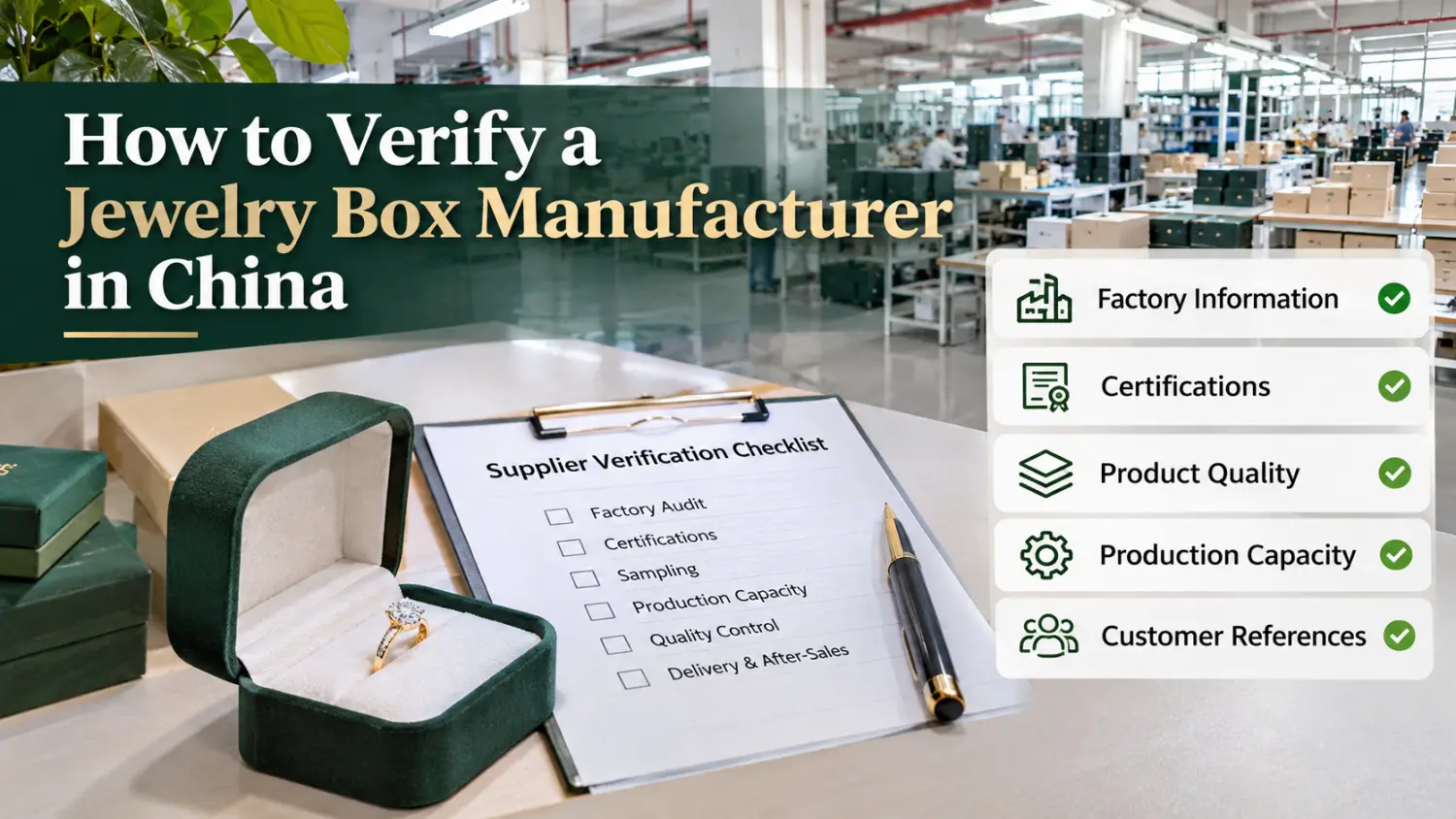
In this guide, we explain how to verify a jewelry box manufacturer in China, what documents to request, how to inspect factory capabilities, and which warning signs buyers should watch for.
1. Check the Company’s Business License and Registration
The first step is to confirm that the supplier is a legally registered Chinese company.
A professional manufacturer should be able to provide its business license (营业执照) and basic company information.
Ask the supplier for:
- Full registered Chinese company name
- Business license
- Unified Social Credit Code
- Company establishment date
- Registered address
- Business scope
- Legal representative
Verify the Business License Online
China’s National Enterprise Credit Information Publicity System allows users to search company registration information.
Website: https://www.gsxt.gov.cn/
You can search using the company’s Chinese registered name or its Unified Social Credit Code.
Check whether:
- The company registration record exists.
- The registration status is active.
- The company name matches the business license.
- The registered address is consistent with the information provided.
- The business scope is relevant to its claimed activities.
For a supplier claiming to be a jewelry box manufacturer, pay attention to whether its registered business scope includes relevant manufacturing or production activities.
An English company name may be different from its official Chinese registered name, so do not rely on the English name alone.
Important: A valid business license confirms the existence of a registered company. It does not prove that the company owns a factory, has production equipment, or manufactures jewelry boxes itself. You need additional evidence to verify its actual manufacturing capability.
2. Confirm Whether It Is a Real Jewelry Box Factory
One of the most important questions is whether you are dealing directly with a manufacturer or a trading company.
Both can be legitimate suppliers, but their business models and production arrangements may be different.
A direct jewelry box manufacturer may have its own production facilities, workers, equipment, production management, and quality control processes.
A trading company may purchase products from several factories and coordinate orders for overseas customers.
Neither model is automatically better for every buyer. The key is to understand who will actually manufacture your jewelry boxes.
Ask About Factory Ownership and Production Locations
Request the following information:
- Factory address
- Factory area
- Number of production workers
- Main production equipment
- Main product categories
- Monthly or daily production capacity
- Whether production processes are outsourced
If the supplier has multiple production locations, ask which facility will handle your specific order.
Request a Live Video Factory Tour
A live video call is more useful than relying only on edited factory videos.
During the call, ask the supplier to show:
- Factory entrance and company identification
- Raw material storage
- Cutting and processing areas
- Jewelry box assembly lines
- Logo printing or finishing areas
- Quality inspection stations
- Finished product storage
- Packing and shipping areas
You can also ask the supplier to show a specific product or production process during the call.
For example, if you plan to purchase velvet ring boxes, ask to see how the factory prepares the velvet material, assembles the box, and installs the ring insert.
This helps you understand whether the supplier has relevant production experience.
3. Evaluate the Factory’s Production Capabilities
A supplier may have a registered company and a factory address, but that does not necessarily mean it can handle your order efficiently.
You should evaluate whether its production capabilities match your product requirements and order quantity.
Check the Main Product Categories
A professional jewelry box manufacturer may produce different types of packaging, including:
- Ring boxes
- Necklace boxes
- Earring boxes
- Bracelet boxes
- Pendant boxes
- Jewelry box sets
- Velvet jewelry boxes
- PU leather jewelry boxes
- Paper jewelry boxes
- LED jewelry boxes
- Jewelry display trays and stands
If you need several types of jewelry boxes, ask whether the supplier can manufacture them within its own production system or whether some products will be outsourced.
Ask About Production Equipment
Depending on the product range, relevant equipment may include:
- Paper cutting and die-cutting machines
- Printing equipment
- Lamination and surface finishing equipment
- Fabric cutting machines
- Sewing machines
- Injection molding machines
- Box forming and assembly equipment
- Logo stamping equipment
Not every factory needs every type of machine. The equipment should be relevant to the products it claims to manufacture.
For example, a factory producing paper jewelry boxes may have different equipment from one specializing in plastic jewelry boxes or velvet packaging.
Understand Its Production Capacity
Ask how many units the factory can produce per day or month.
For larger orders, also ask about:
- Current production workload
- Available production capacity
- Number of production lines
- Normal production lead time
- Ability to handle repeat orders
- Seasonal production arrangements
Do not evaluate a supplier only by the highest capacity number it advertises. Ask whether the figure applies to your specific product type and whether the factory can support your required delivery schedule.
4. Review Product Quality and Manufacturing Details
A reliable jewelry box manufacturer should be able to explain how its products are made and what quality standards it follows.
Do not judge a supplier only by product photos. Examine the actual construction and finishing details.
Check the Materials
Common materials used in jewelry box manufacturing include:
- Paperboard
- 벨벳
- PU leather
- Microfiber
- Wood
- Plastic
- Metal components
Ask the supplier to explain the available material options and their differences.
For example, velvet jewelry boxes may offer a soft, elegant appearance, while PU leather boxes can provide a smooth exterior and a premium presentation. Paper jewelry boxes may be suitable for brands looking for flexible printing and custom packaging designs.
A good manufacturer should be able to recommend materials based on your budget, design, product positioning, and target market.
Inspect Construction and Finishing
Pay attention to:
- Clean edges and corners
- Even surface wrapping
- Consistent stitching
- Secure hinges and magnets
- Smooth opening and closing
- Correct insert dimensions
- Accurate logo placement
- Consistent color and texture
For a jewelry box set, check whether the different pieces have consistent materials, colors, and finishing.
For an LED jewelry box, test the lighting system and confirm that the jewelry is positioned correctly when the box is opened.
These details are important because packaging represents your brand before customers even see the jewelry.
5. Check the Manufacturer’s Quality Control System
Quality control is essential when purchasing custom jewelry boxes in bulk.
A sample may look perfect, but buyers also need confidence that the mass-produced products will meet the same agreed specifications.
Ask the manufacturer to explain its quality control procedures.
A reliable quality management process may include several inspection stages.
Incoming Material Inspection
Before production begins, materials should be checked for obvious defects, incorrect colors, damage, or specification differences.
In-Process Inspection
During production, workers or quality inspectors should check dimensions, assembly, surface finishing, logo application, and other important details.
Finished Product Inspection
Completed jewelry boxes should be inspected for appearance, structure, functionality, and consistency with the approved sample.
Pre-Shipment Inspection
Before packing and shipment, the finished products should undergo final inspection based on the agreed quality requirements.
You can ask for:
- Quality inspection procedures
- Inspection checklists
- Production photos or videos
- Defect handling procedures
- Third-party inspection arrangements
For large orders, consider arranging an independent pre-shipment inspection.
6. Verify Certifications and Compliance Documents
Certifications can help buyers evaluate a supplier’s quality management, environmental practices, or social compliance.
However, buyers should check the actual documents rather than relying on certification logos displayed on a website.
Depending on the factory and product requirements, relevant certifications or reports may include:
- ISO 9001 for quality management systems
- FSC for eligible responsibly sourced paper and forest-related products
- BSCI or Sedex-related social compliance assessments
- RoHS reports for applicable restricted substances and product requirements
- REACH-related documentation where relevant
- FDA-related documentation where a specific product or material application requires it
Not every certificate applies to every jewelry box. For example, a certification covering a particular paper material should not automatically be treated as certification for every product manufactured by the company.
What Should Buyers Verify?
Check the following details:
- Company name on the certificate
- Issuing organization
- Certificate or report number
- Validity period, if applicable
- Covered activities or product scope
- Whether the document can be independently verified
You can also contact the issuing organization or use its official verification service when available.
A certificate belonging to a different company in the same business group does not automatically prove that your contracting supplier or production site is covered.
7. Request Samples Before Placing a Bulk Order
One of the most practical ways to evaluate a jewelry box manufacturer is to order samples.
A sample allows you to inspect the actual product rather than relying on photos or descriptions.
What Should You Check?
When receiving a sample, evaluate:
Material quality: Does the material match your expectations in terms of texture, thickness, and appearance?
Dimensions: Are the external and internal measurements correct?
Structure: Does the box open and close properly? Are the magnets, hinges, and drawers working smoothly?
Logo: Is the logo size, position, color, and finishing correct?
Interior insert: Does the insert hold the jewelry securely without damaging it?
Overall finishing: Are there scratches, glue marks, uneven edges, or other visible defects?
If the sample needs changes, provide clear feedback before approving mass production.
Why Sample Approval Matters
The approved sample should become the reference for bulk production.
Keep a copy of the confirmed specifications, including materials, dimensions, colors, logo artwork, and insert details.
This makes it easier to compare the finished bulk order with the original approved design.
8. Check Export Experience and Communication Skills
For international buyers, a jewelry box manufacturer should understand the basic requirements of overseas orders.
Ask whether the supplier has experience working with customers in your target market.
Useful questions include:
- Which countries or regions do you regularly serve?
- Have you supplied jewelry packaging to wholesalers or jewelry brands?
- Can you prepare export packing lists and commercial invoices?
- Can you coordinate international shipping?
- Can you provide product specifications and supporting documents?
- Can you communicate clearly in English?
Export experience can make the purchasing process smoother, especially when dealing with custom specifications, shipping schedules, and documentation.
Evaluate Communication Before Ordering
Pay attention to how the supplier handles your initial inquiry.
A professional supplier should be able to:
- Understand your product requirements
- Answer technical questions
- Explain material and structure options
- Provide clear quotations
- Communicate realistic lead times
- Follow up on sample development
- Explain potential production limitations
If the supplier cannot clearly explain the product or production process before receiving an order, communication may become more difficult during mass production.
9. Compare Quotations and Understand the Real Cost
Price is an important factor, but the lowest quotation is not always the best choice.
When comparing jewelry box manufacturers, make sure the quotations are based on the same specifications.
Check whether each quotation includes:
- Product dimensions
- Material specifications
- Logo printing or finishing
- Interior inserts
- Accessories
- Individual packaging
- Carton packing
- Sample costs
- Tooling or mold costs, if applicable
- Shipping costs, if included
A supplier may offer a lower price because it uses different materials, simpler construction, or less detailed finishing.
Ask for a clear breakdown if the quotation is significantly lower than other offers.
Also compare the manufacturer’s MOQ, sample lead time, mass production time, and after-sales support.
A slightly higher unit price may provide better value if the supplier offers more consistent quality and reliable production management.
10. Verify Payment Details and Contract Information
Before paying a deposit, confirm that the legal entity receiving your payment is the company you have verified.
Check that the company name on the following documents is consistent:
- Business license
- Quotation
- Sales contract or purchase order
- Commercial invoice
- Bank account beneficiary
If different companies are involved, ask the supplier to explain their relationship and document the arrangement.
Avoid paying an individual’s personal bank account without a clear, independently verified reason.
If the supplier requests a last-minute change to its bank details, confirm the change through a trusted contact channel before transferring money.
Put Important Requirements in Writing
Your purchase agreement should clearly state:
- Product specifications
- Materials and dimensions
- Approved sample reference
- Logo requirements
- Order quantity
- Unit price and total price
- Production lead time
- Inspection requirements
- Packaging and shipping arrangements
- Payment terms
- Responsibility for quality issues
For large or customized orders, written agreements help reduce misunderstandings.
11. Watch for These Warning Signs
During supplier verification, pay attention to the following red flags.
1. The supplier refuses to provide its business license
A legitimate registered company should be able to provide basic registration information.
2. The company name does not match the payment details
Unexplained differences between the registered entity, contract party, and bank beneficiary should be investigated before payment.
3. The supplier cannot show real production facilities
If a company claims to be a manufacturer but refuses a live factory tour or cannot explain its production process, request additional evidence.
4. Product photos are the only proof of manufacturing capability
Product photos can demonstrate appearance, but they do not prove factory ownership or production capacity.
5. The quotation is unusually low
A price far below comparable offers may indicate different specifications, hidden costs, or unrealistic promises.
6. The supplier promises everything without asking technical questions
Custom jewelry box production requires detailed information. A supplier that never asks about dimensions, materials, inserts, logo methods, or quantities may not have properly evaluated your project.
7. The supplier pressures you to pay immediately
Take time to verify the company, review the contract, and confirm payment details before transferring money.
12. A Practical Checklist for Verifying a China Jewelry Box Manufacturer
Before placing your first bulk order, use this checklist to organize your supplier evaluation.
- Obtain the company’s Chinese business license.
- Verify the Unified Social Credit Code through China’s official company registry.
- Confirm the company registration status and business scope.
- Identify the actual production address.
- Confirm whether the supplier is a manufacturer or trading company.
- Request a live video factory tour.
- Review relevant production equipment and facilities.
- Confirm production capacity for your product type.
- Check quality control procedures.
- Verify relevant certificates and test reports.
- Order and inspect physical samples.
- Confirm the approved sample and written specifications.
- Compare quotations based on identical requirements.
- Match the contract, invoice, and bank beneficiary.
- Consider an independent inspection for a large first order.
Completing these checks will give you a clearer picture of the supplier’s legal identity, production capability, and ability to manage your order.
13. Why Choose Yaneng as Your China Jewelry Box Manufacturer?
Finding a suitable jewelry box manufacturer is not just about checking documents. Buyers also need a supplier that understands custom packaging, has relevant production experience, and can support projects from sample development to bulk manufacturing.
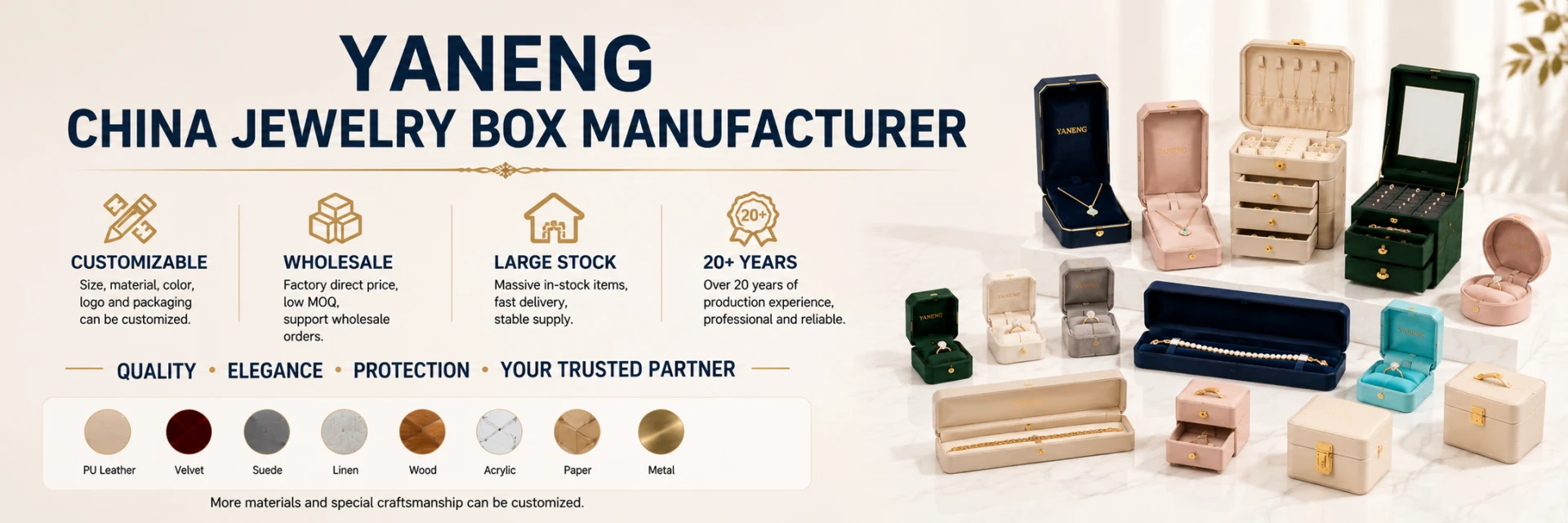
Guangzhou Yaneng Packing Co., Ltd. is a China-based jewelry box manufacturer established in 2005. With approximately 5,000 square meters of factory space, a design team, and manufacturing resources in Guangzhou and Yiwu, Yaneng provides jewelry packaging solutions for international B2B customers.
Our product range includes:
- Custom ring boxes
- Necklace and earring boxes
- Bracelet and pendant boxes
- Velvet jewelry boxes
- PU leather jewelry boxes
- Paper jewelry boxes
- LED jewelry boxes
- Wholesale jewelry box sets
- Jewelry display trays and stands
- Jewelry pouches and related packaging accessories
What Can Yaneng Support?
Custom OEM and ODM Services
We support custom dimensions, materials, colors, structures, and logo applications based on buyers’ requirements.
Sample Development
Buyers can discuss their designs with our team and develop samples before confirming bulk production.
Manufacturing Experience
With more than 20 years of experience in jewelry packaging, Yaneng understands the production requirements of different jewelry box styles and materials.
Quality Inspection
We conduct quality checks during production and before shipment to help ensure that finished products meet the agreed specifications.
Support for Wholesale and Custom Orders
We work with jewelry brands, wholesalers, distributors, and trading companies that need customized packaging and repeat bulk orders.
We believe that a reliable manufacturing partnership should be based on clear communication, realistic production planning, consistent quality, and long-term cooperation.
If you are looking for a China jewelry box manufacturer, we welcome you to learn more about our factory and discuss your packaging project.
Contact Yaneng for Custom Jewelry Box Solutions
Send us your product requirements, reference photos, dimensions, logo artwork, and estimated order quantity. Our team can review your project and provide suitable recommendations.
Website: https://jewelpackage.com/
Email: [email protected]
WhatsApp: +86 175 0205 9429
결론
Verifying a jewelry box manufacturer in China requires more than checking a website or comparing quotations.
Buyers should confirm the company’s legal registration, understand whether it operates a real factory, review its production capabilities, inspect product samples, verify relevant certifications, and check its quality control procedures.
Payment details and contract information should also be carefully reviewed before placing a deposit.
By following a structured verification process, jewelry brands, wholesalers, and distributors can reduce sourcing risks and make more informed purchasing decisions.
The right jewelry box manufacturer should not only offer competitive prices but also demonstrate the production experience, communication, quality management, and manufacturing capability needed to support your business over the long term.