

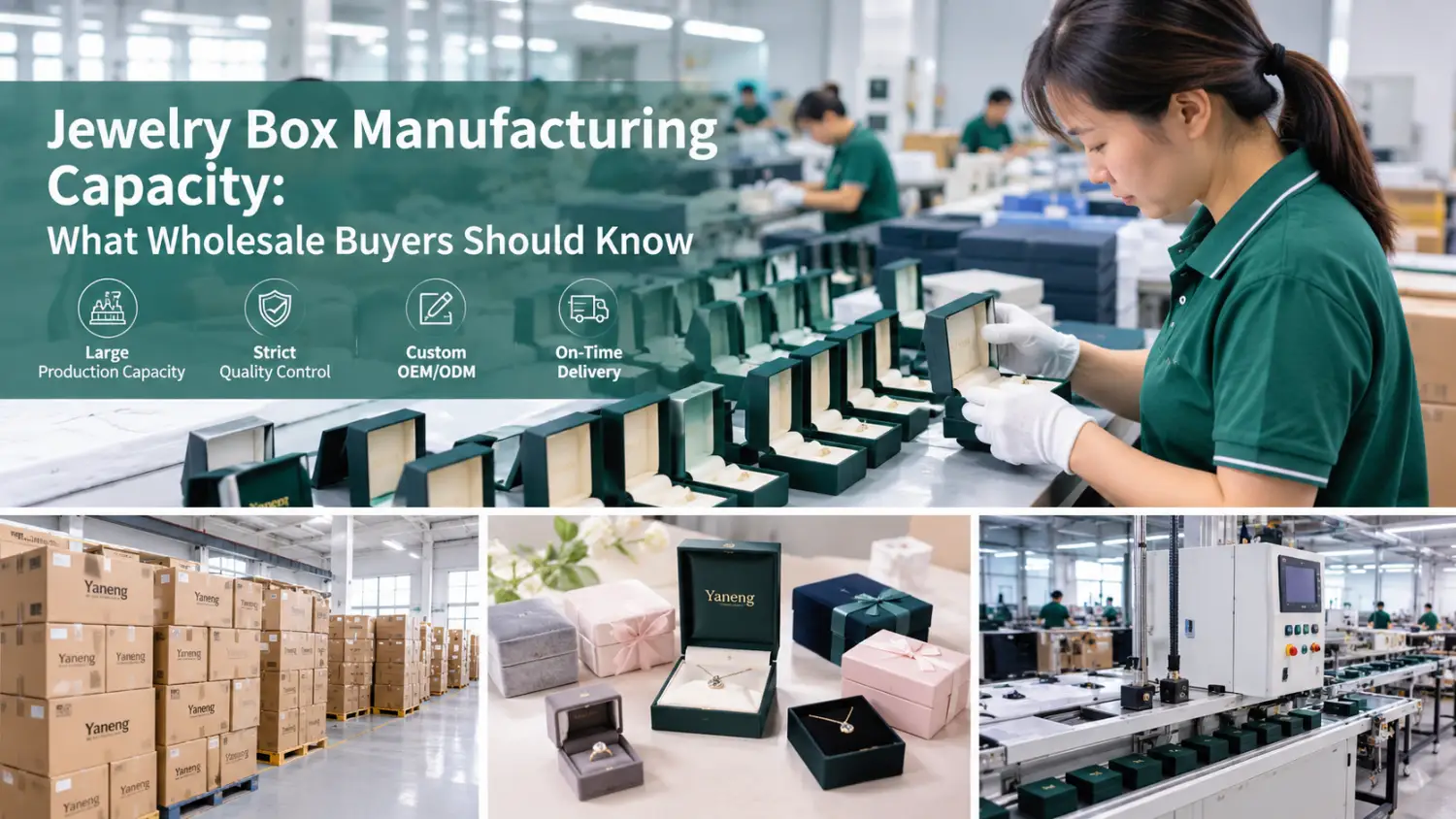
Jewelry Box Manufacturing Capacity: What Wholesale Buyers Should Know
When sourcing jewelry boxes in bulk, price is important, but it is not the only factor that determines whether an order will be successful. A supplier must also have the production capacity, equipment, workers, مواد, ، و quality control systems to handle your order reliably.
For jewelry brands, wholesalers, distributors, and trading companies, choosing a factory with suitable manufacturing capacity can help reduce supply risks, maintain product consistency, and support long-term business growth.
However, how can you tell whether a مصنع صناديق مجوهرات can really handle your order? Is a large factory always a better choice? What production figures should you ask about before placing a wholesale order?
This guide explains the key factors buyers should understand when evaluating صندوق مجوهرات manufacturing capacity and selecting a reliable wholesale supplier.
1. What Does Jewelry Box Manufacturing Capacity Mean?
Jewelry box manufacturing capacity refers to the number of products a factory can produce within a specific period under certain production conditions.
It is usually measured by daily, monthly, or annual output. However, production capacity is not simply about how many boxes a factory can make.
A reliable manufacturer should be able to manage the complete production process, including:
- Raw material purchasing and preparation
- Box structure development and sampling
- Printing and surface treatment
- Cutting, forming, and assembly
- Insert production and installation
- Logo customization
- Quality inspection
- Packaging and shipment preparation
Different jewelry box styles require different production processes. For example, a simple paper ring box may be easier to manufacture in large quantities than a multi-layer jewelry storage box with several compartments.
Therefore, wholesale buyers should evaluate production capacity based on their actual product requirements rather than relying only on a factory’s total output figures.
2. Why Manufacturing Capacity Matters to Wholesale Buyers
Manufacturing capacity directly affects how a supplier handles large orders, repeat orders, and changing market demand.
Handling Large Wholesale Orders
If you are a jewelry wholesaler or distributor, you may need thousands of jewelry boxes in one order. A factory with sufficient production resources can organize materials, workers, and production schedules more effectively.
Before placing a large order, ask the supplier whether it has experience producing similar quantities and product styles.
A factory that mainly handles small orders may not be suitable for a large wholesale project, especially when the order includes multiple sizes, colors, and customized logos.
Maintaining Stable Product Quality
Large-scale production requires consistent manufacturing standards.
For example, when ordering 5,000 velvet ring boxes, buyers expect the color, dimensions, lining, logo position, and overall appearance to remain consistent throughout the order.
A professional jewelry box factory should have clear production specifications and quality inspection procedures to reduce differences between batches.
Supporting Repeat Orders
For established jewelry brands, packaging is part of the overall brand identity. When customers reorder the same jewelry boxes, they expect the new batch to match the previous one.
A manufacturer with organized production records, material specifications, and approved samples can make repeat orders easier to manage.
Meeting Delivery Schedules
Late packaging deliveries can affect product launches, promotional campaigns, seasonal sales, and inventory planning.
A factory with sufficient production capacity and good scheduling can better coordinate workers, materials, and manufacturing processes.
However, buyers should remember that production capacity alone does not guarantee on-time delivery. Material availability, order complexity, factory workload, and quality inspection also affect the final schedule.
3. Key Factors That Determine a Jewelry Box Factory’s Production Capacity
When evaluating a jewelry box manufacturer, do not focus on just one number. Consider the following factors together.
Factory Size and Production Space
Factory size can provide useful information about a manufacturer’s production resources.
A larger production facility may provide more room for:
- Raw material storage
- Production equipment
- Assembly lines
- Quality inspection areas
- Finished product storage
- Packing and shipping preparation
However, factory size should not be treated as direct proof of manufacturing capacity. Buyers should also check the equipment, workforce, production organization, and actual output.
Manufacturing Equipment
Production equipment helps factories improve efficiency and maintain consistent product quality.
Depending on the jewelry box materials and structures, a manufacturer may use equipment for paper cutting, printing, forming, injection molding, sewing, surface treatment, and assembly.
For example:
- Paper jewelry boxes require cutting, forming, wrapping, and assembly processes.
- Plastic jewelry boxes may require injection molding and component assembly.
- Velvet jewelry boxes require material preparation, lining, wrapping, and detailed finishing.
- Jewelry pouches require fabric cutting, sewing, and finishing.
When evaluating a supplier, ask whether the equipment is suitable for your required product type and whether important manufacturing processes are handled in-house.
Number of Production Workers
Skilled workers are essential for jewelry packaging manufacturing, especially for products that require detailed hand assembly.
Some jewelry boxes involve complicated structures, precise insert installation, fabric wrapping, and logo application. These processes require experience and careful workmanship.
A factory with an organized production team can allocate workers according to different product categories and order requirements.
Raw Material Supply
Even when a factory has enough equipment and workers, production can be delayed if materials are unavailable.
Common jewelry box materials include:
- Paperboard and specialty paper
- Velvet and microfiber
- PU leather
- Wood
- Metal accessories
- Plastic components
- Foam and custom inserts
For customized wholesale orders, buyers should confirm whether the factory can secure the required materials in advance.
This is particularly important when ordering special colors, custom fabrics, unique box structures, or branded accessories.
4. How to Evaluate a Factory’s Actual Production Output
Production capacity figures are useful, but buyers should understand what those numbers represent.
A factory may report its daily output for paper boxes, plastic boxes, or pouches. These figures may refer to different product categories and production processes.
When reviewing a manufacturer’s production capacity, ask:
- Is the output measured per day, month, or year?
- Does it refer to one product category or all products?
- Is it the output of unfinished components or completed products?
- Does it include quality inspection and packaging?
- Can the factory maintain this output during peak seasons?
- How much capacity is currently available for new orders?
These questions help you understand whether the factory’s production figures are relevant to your purchasing requirements.
Example: Different Jewelry Box Categories
A manufacturer may have separate production arrangements for paper jewelry boxes, plastic jewelry boxes, and jewelry pouches.
These categories use different equipment, workers, and manufacturing processes. Their daily output should therefore be evaluated separately.
For wholesale buyers, the most important question is not simply how many products the factory makes every day. It is whether the supplier can manufacture your specific products in the required quantity and quality within your delivery schedule.
5. Yaneng Jewelry Box Factory: Manufacturing Capacity and Production Resources
Choosing a manufacturer with relevant production experience can make wholesale purchasing easier.
Guangzhou Yaneng Packing Co., Ltd. is a China-based jewelry packaging manufacturer established in 2005. With more than 20 years of experience in jewelry packaging, Yaneng provides customized jewelry boxes, jewelry box sets, display products, pouches, and related packaging solutions for jewelry brands, wholesalers, and trading companies.
5,000 m² Factory and Experienced Production Team
Yaneng operates a production facility of approximately 5,000 m² in Guangzhou, with an additional factory branch in Yiwu.
The company has more than 300 employees and an experienced team covering product design, manufacturing, quality inspection, and order coordination.
This production structure supports different jewelry packaging projects, from standard wholesale products to customized OEM and ODM orders.
Daily Production Capacity
Yaneng’s reported daily production capacities include:
- Paper boxes: up to 15,000 pieces per day
- Plastic jewelry boxes: up to 18,000 pieces per day
- Jewelry pouches: up to 22,000 pieces per day
These figures represent different product categories and should not be added together as the capacity for one jewelry box style.
Actual output depends on product structure, material, customization requirements, order quantity, and production scheduling.
For wholesale buyers, this range of production resources provides flexibility when sourcing different types of jewelry packaging from one supplier.
Multiple Jewelry Packaging Products
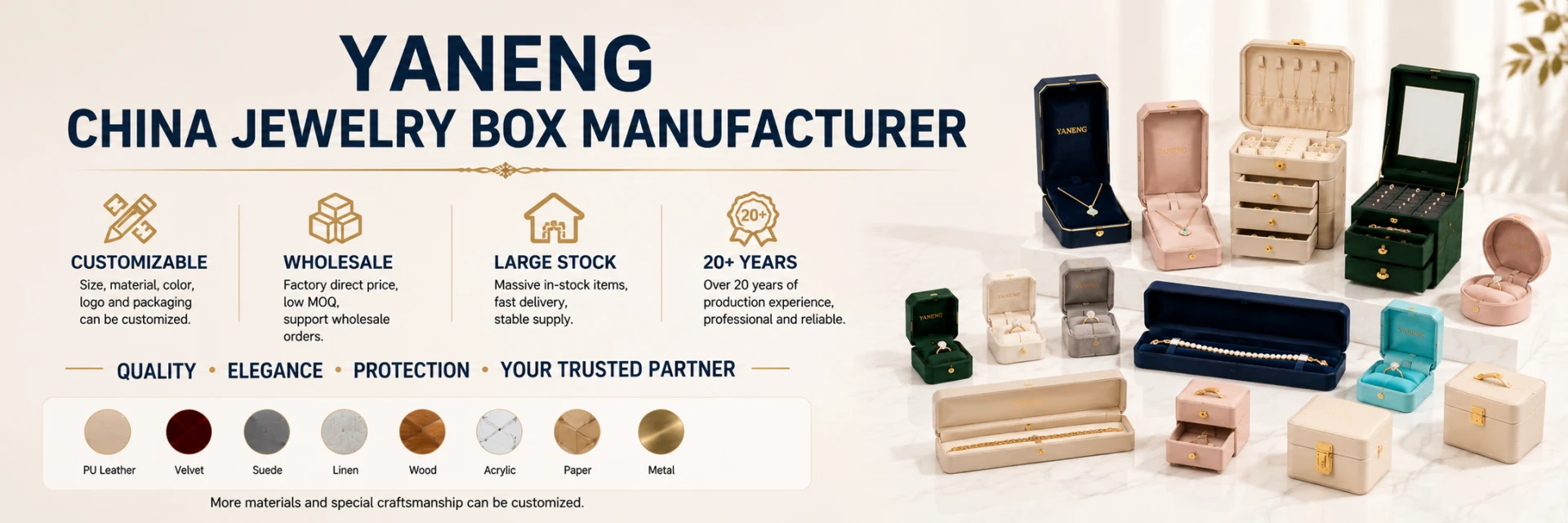
Yaneng does not focus on only one jewelry box style. Its product range includes:
- Ring boxes
- Necklace boxes
- Earring boxes
- Bracelet boxes
- Velvet jewelry boxes
- PU leather jewelry boxes
- Paper jewelry boxes
- LED jewelry boxes
- Jewelry box sets
- Jewelry display trays and stands
- Jewelry pouches
For buyers who need a complete packaging collection, sourcing several related products from one manufacturer can simplify supplier communication and order coordination.
Design and Customization Support
Different jewelry brands have different packaging requirements.
Some buyers need a simple logo printed on an existing jewelry box, while others require customized dimensions, materials, colors, inserts, and packaging structures.
Yaneng provides design support and OEM/ODM customization to help buyers develop packaging that matches their products and brand identity.
Before mass production, buyers can confirm the structure, material, logo, and appearance through the sample process.
6. Why Quality Control Is Essential for High-Volume Jewelry Box Production
A factory’s production capacity is valuable only when it can maintain consistent quality.
For wholesale orders, even a small defect rate can affect hundreds of products. This can create additional costs for inspection, replacement, repacking, and customer service.
A professional jewelry box manufacturer should establish quality checks throughout the manufacturing process.
Incoming Material Inspection
Materials should be checked before entering production.
For example, paper, velvet, PU leather, metal accessories, and inserts should be inspected against the approved specifications.
This helps reduce problems caused by incorrect materials, color differences, or damaged components.
In-Process Quality Inspection
Quality inspection should not happen only after all products have been completed.
During production, workers and QC staff should check important details such as:
- Box dimensions and structure
- Surface material and color
- Logo position and printing quality
- Lid opening and closing
- Insert installation
- Adhesion and finishing
- Overall appearance
Identifying problems early can reduce the number of defective products in a large order.
Final Inspection Before Shipment
Before shipment, finished jewelry boxes should be checked according to the agreed quality requirements.
Yaneng follows multiple quality control procedures, including 10–12 QC processes and three full-inspection stages. The company reports a 100% inspection commitment before shipment.
For buyers, it is still important to confirm the inspection scope, acceptance criteria, and any special requirements in the purchase order.
7. How to Estimate Production Lead Time for Wholesale Jewelry Boxes
Production capacity and production lead time are related, but they are not the same.
A factory may have high daily output but still need additional time for customized materials, sample approval, or complex box structures.
When requesting a quotation, ask the manufacturer to separate the following stages.
Sample Development
Custom jewelry boxes usually require a sample before mass production.
The sample allows buyers to confirm dimensions, materials, colors, inserts, logo placement, and overall appearance.
Yaneng’s typical sample proofing period is approximately 5–7 days, depending on the product design and customization requirements.
Material Preparation
After the sample is approved, the factory may need to prepare paper, velvet, PU leather, inserts, hardware, and other components.
Special materials or custom colors may require additional sourcing time.
Mass Production
The mass production schedule depends on order quantity, product complexity, material availability, and the factory’s current workload.
Simple products using existing materials may be easier to schedule than complicated customized jewelry box sets.
Ask the supplier to provide a production schedule based on your actual order rather than relying on a general lead-time promise.
Quality Inspection and Packaging
The production schedule should also include final inspection, correction of any defects, carton packing, and shipment preparation.
Remember that factory production time is not the same as international delivery time. Freight, customs clearance, and destination handling should be considered separately.
8. Questions Wholesale Buyers Should Ask Before Choosing a Jewelry Box Manufacturer
Before placing a large order, buyers should ask suppliers clear questions about their manufacturing capabilities.
Here are some useful questions:
1. What is your daily or monthly production capacity for my required jewelry box style?
Ask for product-specific figures rather than a general factory output number.
2. Do you manufacture the products in your own factory?
Confirm which production processes are handled in-house and which are outsourced.
3. Can you handle large orders and repeat orders?
Ask about production scheduling and how repeat orders are managed.
4. What quality control procedures do you use?
Understand how materials, semi-finished products, and finished products are inspected.
5. How long does sample development take?
Confirm the sample schedule and how many rounds of revisions may be needed.
6. Can you customize materials, colors, dimensions, and logos?
Make sure the factory can meet your brand’s packaging requirements.
7. Can you provide production photos or videos?
Factory photos, production videos, and relevant product samples can help you understand the supplier’s manufacturing resources.
9. How to Choose the Right Jewelry Box Factory for Long-Term Wholesale Cooperation
The best manufacturer is not necessarily the one with the largest factory or the lowest quotation.
For long-term cooperation, wholesale buyers should consider several factors together.
Relevant Manufacturing Experience
Choose a supplier with experience in the jewelry box styles you need. Manufacturing experience can help reduce design mistakes and improve communication during customization.
Stable Production and Quality
A reliable manufacturer should have suitable equipment, experienced workers, organized production procedures, and clear inspection standards.
Flexible Customization
Your packaging requirements may change as your product range grows. A supplier that can support different materials, structures, colors, and logo methods can make future product development easier.
Transparent Communication
A professional supplier should explain production schedules, material requirements, MOQ, sample costs, and delivery arrangements clearly.
Long-Term Supply Support
For wholesalers and jewelry brands, packaging is an ongoing purchasing requirement. Choose a factory that can support repeat orders and maintain consistent product specifications.
10. Get Wholesale Jewelry Boxes Directly from Yaneng
If you are looking for a reliable China jewelry box manufacturer, Yaneng can support your wholesale and تغليف مخصص projects.
Established in 2005, Guangzhou Yaneng Packaging Co., Ltd. combines more than 20 years of industry experience with factory production resources, design support, and quality control procedures.
Our services include:
- Wholesale jewelry boxes and jewelry box sets
- Custom jewelry boxes with logo
- OEM and ODM jewelry packaging
- Velvet, PU leather, paper, and plastic jewelry boxes
- Jewelry display trays, stands, and pouches
- Custom packaging design and sample development
- Production inspection and shipment coordination
Whether you are a jewelry brand, wholesaler, distributor, or trading company, our team can help you evaluate suitable packaging styles according to your product requirements, order quantity, and target budget.
Planning a wholesale jewelry box order?
Contact Yaneng and send us your product type, estimated quantity, preferred materials, logo artwork, and target delivery date.
Our team can help you review the packaging requirements and provide a suitable manufacturing solution.
Visit: https://jewelpackage.com/
Email: [email protected]
WhatsApp: +86 175 0205 9429
خاتمة
Jewelry box manufacturing capacity is an important factor when choosing a wholesale packaging supplier. However, buyers should look beyond factory size and daily output figures.
Equipment, skilled workers, material supply, production scheduling, quality control, and delivery management all contribute to a manufacturer’s ability to handle wholesale orders.
Before choosing a supplier, evaluate its experience with your specific jewelry box style, ask for clear production information, and confirm the sample and inspection process.
Working with a manufacturer that understands both production requirements and wholesale purchasing needs can help your business build a more stable jewelry packaging supply chain.