





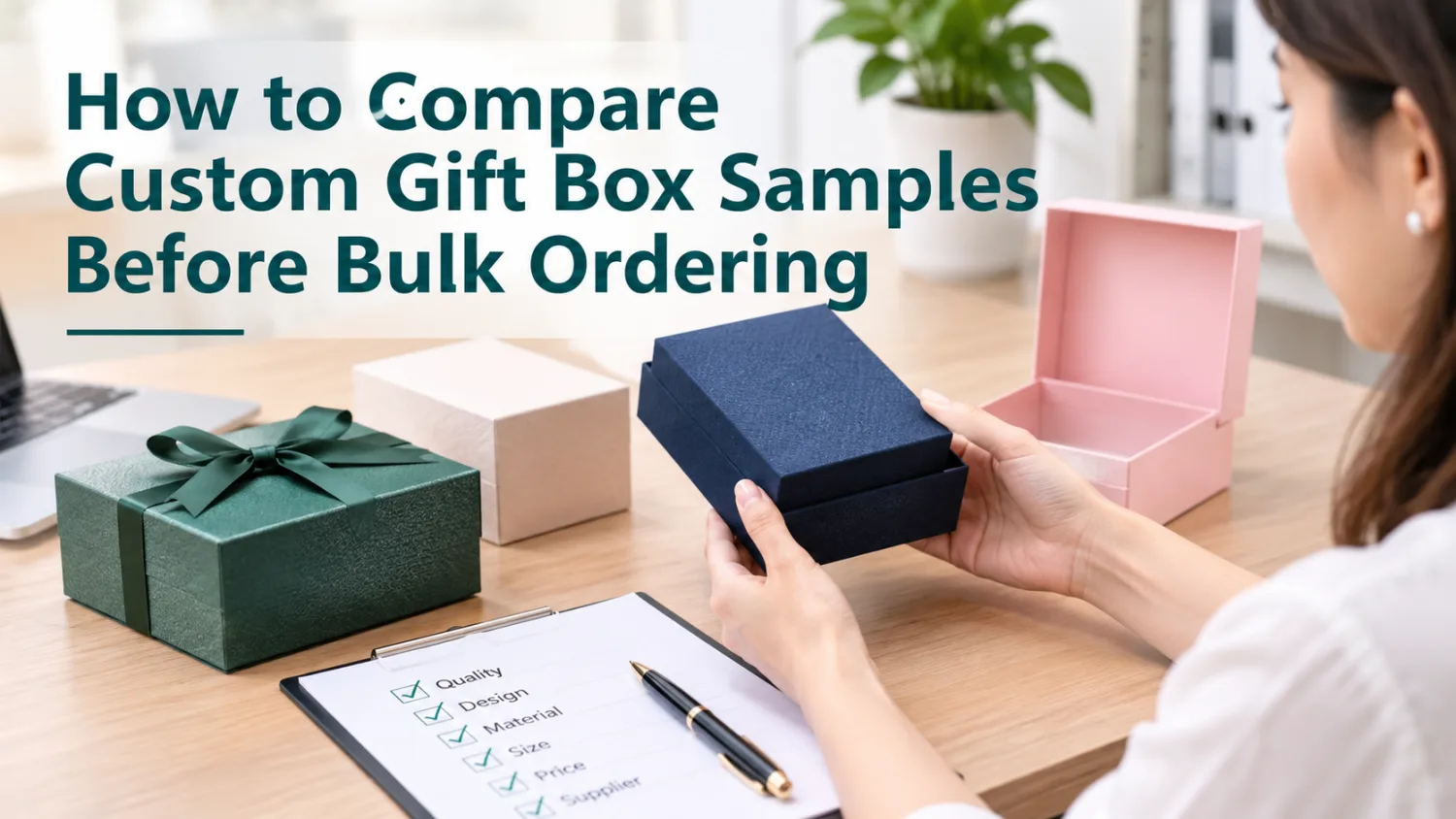
How to Compare Custom Gift Box Samples Before Bulk Ordering
Ordering custom gift boxes in bulk is an important investment for wholesalers, retailers, gift brands, and packaging distributors. Before confirming a large order, buyers should carefully evaluate product samples to make sure the final packaging meets their expectations.
A sample may look attractive in a supplier’s photos, but the actual product can reveal differences in material quality, box structure, printing, color, assembly, and finishing. These details become even more important when ordering hundreds or thousands of boxes.
Comparing samples from different suppliers is not simply about choosing the most attractive design or the lowest price. It is about identifying which manufacturer can consistently produce the required packaging quality at the right cost and within the expected delivery schedule.
This guide explains how to compare custom gift box samples, what details to inspect, how to evaluate different suppliers, and what to confirm before placing a bulk order.
1. Why Compare Custom Gift Box Samples Before Bulk Ordering?
A physical sample allows buyers to evaluate packaging details that may not be clear in digital designs or product photographs.
For B2B buyers, sample comparison offers several advantages.
Confirm Actual Product Quality
Photos cannot fully show the thickness of the board, surface texture, corner finishing, adhesive quality, or overall construction.
Handling a physical sample helps buyers understand whether the box feels strong, looks professional, and meets the intended product positioning.
Identify Design and Structural Problems
A sample can reveal problems such as:
- A lid that does not fit properly
- A magnetic closure that is too weak
- A drawer that is difficult to open
- An insert that does not hold the product securely
- Wrinkled wrapping paper
- Misaligned printing or logos
Finding these issues before bulk production can prevent costly corrections later.
Compare Different Manufacturers Fairly
When several suppliers provide samples, buyers can compare their materials, production quality, customization capabilities, and communication.
This helps identify whether a supplier can meet the requirements of a long-term wholesale relationship.
Reduce Bulk Order Risks
A sample approval process gives both the buyer and manufacturer a clearer reference for mass production.
It helps reduce misunderstandings about dimensions, colors, materials, finishing, and structural details.
2. Prepare the Same Specifications for Every Supplier
Before comparing samples, make sure all suppliers understand the same requirements.
If each manufacturer produces a sample based on different specifications, the comparison may not be accurate.
Prepare a clear packaging brief covering the following details.
Box Dimensions
Provide the required length, width, and height.
If the box needs to hold a specific product, include the product dimensions and, when possible, provide an actual product sample.
Also confirm whether the measurements refer to the internal or external dimensions.
Box Structure
Specify the required structure, such as:
- Lid and base gift box
- Magnetic closure gift box
- Drawer gift box
- Flip-top gift box
- Foldable rigid gift box
- Window gift box
- Custom-shaped gift box
Different structures involve different materials and manufacturing processes, so they should not be treated as identical options.
Material Requirements
Tell suppliers which materials you prefer.
Common choices include rigid greyboard, coated paper, specialty paper, kraft paper, textured paper, and different types of interior lining.
If you are still comparing options, ask suppliers to recommend suitable materials based on your budget and product requirements.
Logo and Printing Details
Provide your logo artwork, brand colors, printing requirements, and preferred finishing methods.
For example, you may need hot foil stamping, embossing, debossing, matte lamination, or UV coating.
Estimated Order Quantity
Tell each supplier your expected bulk quantity.
The order quantity can affect material purchasing, production arrangements, and unit pricing.
Packaging and Delivery Requirements
Specify whether each box needs individual protection, inner cartons, custom inserts, or special export packing.
Also provide the destination country and target delivery date when requesting quotations.
Using the same specifications makes supplier comparisons more meaningful.
3. Compare the Material Quality
Material quality is one of the first things to inspect when comparing custom gift box samples.
Two boxes may look similar in photographs but feel very different when handled.
Check the Board Thickness and Strength
For rigid gift boxes, inspect the thickness and stability of the board.
A good rigid box should maintain its intended shape and feel appropriate for the product it holds.
Check whether:
- The sides are straight and stable.
- The bottom does not bend easily.
- The corners are firmly connected.
- The lid maintains its shape.
- The box does not feel excessively weak.
The thickest board is not always the best option. The right thickness depends on the box size, product weight, structure, and intended use.
Compare the Outer Paper
The wrapping paper affects both appearance and customer experience.
Inspect:
- Paper thickness
- Surface texture
- Color consistency
- Scratch resistance
- Print clarity
- Surface smoothness
For premium gift packaging, the paper should match the brand’s positioning.
Check the Interior Materials
Do not focus only on the outside of the box.
Open each sample and inspect the inner lining, insert, and internal finishing.
Look for exposed board edges, loose fabric, uneven adhesive, or poorly fitted inserts.
If the box holds fragile or valuable products, check whether the interior provides sufficient support.
4. Evaluate the Box Structure and Functionality
A gift box should not only look attractive. It must also function properly.
Different box structures require different tests.
Lid and Base Gift Boxes
Check whether the lid fits evenly over the base.
It should open and close without excessive force, while remaining secure enough to prevent unwanted movement.
Pay attention to gaps between the lid and base, uneven edges, and loose corners.
Magnetic Closure Gift Boxes
For magnetic gift boxes, test the opening and closing action several times.
Check whether the magnets are positioned correctly, whether the lid closes evenly, and whether the magnetic force is suitable.
A closure that is too weak may not hold properly, while an overly strong closure can make the box inconvenient to open.
Drawer Gift Boxes
Slide the drawer in and out several times.
Check whether it moves smoothly, whether the tray stays aligned, and whether the outer sleeve provides sufficient support.
The drawer should not be so tight that customers struggle to open it or so loose that it slides out unexpectedly.
Foldable Rigid Gift Boxes
Foldable boxes should be checked for folding accuracy, corner alignment, and structural stability after assembly.
If the packaging is designed to save storage and shipping space, also confirm that it can be assembled easily.
5. Compare Printing and Logo Finishing
Brand presentation is one of the main reasons companies invest in custom gift boxes.
A small difference in logo position, color, or finishing can affect the overall appearance of the packaging.
Check Logo Position and Alignment
Compare the position of the logo on every sample.
It should be correctly aligned and consistent with the approved artwork.
Look for:
- Incorrect logo placement
- Uneven spacing
- Distorted artwork
- Blurred printing
- Inconsistent logo size
Compare Color Accuracy
Check whether the printed colors match your brand guidelines.
Whenever possible, compare samples under similar lighting conditions.
Different lighting environments can make the same color appear slightly different.
For important brand colors, provide a reference color value and request a physical color approval where necessary.
Inspect Special Finishing
If your gift box uses foil stamping, embossing, or other decorative techniques, inspect these areas carefully.
Check whether the foil is evenly applied, the embossed details are clear, and the finishing is clean without obvious defects.
A premium logo finish should look intentional and consistent rather than uneven or poorly positioned.
6. Inspect the Corners, Edges, and Overall Workmanship
Small finishing details often distinguish a professional gift box from a lower-quality product.
When comparing samples, spend time checking the areas where different materials meet.
Corner Finishing
Look at all four corners of the box.
The wrapping paper should be neatly folded, with no obvious gaps, exposed board, or excessive overlapping material.
Poor corner finishing can make a gift box look unfinished.
Edge Wrapping
Check whether the paper is firmly attached around the edges.
Look for lifting paper, visible adhesive, uneven folds, or damaged edges.
Surface Cleanliness
Inspect the box under good lighting.
Check for dust, stains, scratches, fingerprints, glue marks, and other visible defects.
Assembly Consistency
If the box includes several components, make sure they fit together correctly.
The lid, base, drawer, insert, and accessories should form a complete and functional packaging product.
7. Test the Actual Product Fit and Protection
One of the most important parts of sample evaluation is checking the box with the product it will contain.
A box may look perfect when empty but fail to hold the actual product correctly.
Test the Internal Dimensions
Place the product inside the sample and check the available space.
The product should fit without excessive pressure or unwanted movement.
If the packaging includes an insert, check that it matches the product’s shape and dimensions.
Check Product Protection
Move the closed box gently and observe whether the product shifts inside.
For fragile products, consider whether additional foam, EVA, paperboard dividers, or other protective materials are needed.
Check Product Removal
The product should be easy to remove without damaging the packaging or requiring excessive force.
This is particularly important for gift boxes used in retail environments, where customers expect a convenient unboxing experience.
Evaluate the Complete Presentation
Close the box and open it as a customer would.
Consider whether the product is presented neatly, whether the insert looks professional, and whether the packaging communicates the intended brand image.
8. Compare Sample Quality and Supplier Consistency
When receiving samples from multiple manufacturers, do not evaluate only the best-looking product.
You should also consider whether the supplier can reproduce the same quality in bulk production.
Review Sample Production Accuracy
Compare each sample with your original specifications.
Check whether the manufacturer followed the requested dimensions, structure, materials, printing, and finishing details.
A supplier that carefully follows the brief is more likely to understand your production requirements.
Ask About Production Quality Control
Ask how the manufacturer controls quality during mass production.
Useful questions include:
- How are incoming materials inspected?
- How are printing colors checked?
- How are dimensions controlled?
- How are assembly defects identified?
- Are finished products inspected before shipment?
- How are defective products handled?
A supplier should be able to explain its quality control process clearly.
Ask Whether the Sample Represents Bulk Production
A sample should be a realistic reference for the final order.
Confirm whether the same materials, production methods, and finishing techniques will be used during mass production.
If any materials or processes will change, ask for an explanation before approving the sample.
9. Compare the Total Quotation, Not Just the Sample Price
A low sample price does not necessarily mean a low bulk order cost.
When comparing suppliers, review the complete quotation and make sure the specifications are identical.
Consider the following cost factors:
- Box dimensions and structure
- Board thickness
- Outer wrapping paper
- Interior lining
- Printing and logo finishing
- Inserts and accessories
- Order quantity
- Individual packaging
- Export carton requirements
- Sample and tooling charges
- Shipping arrangements
Also ask whether sample fees can be credited toward a confirmed bulk order.
Some manufacturers offer this arrangement, but the terms should be confirmed in advance.
Compare Value Instead of Only Unit Price
A slightly more expensive sample may offer better materials, more accurate printing, stronger construction, and better finishing.
For wholesale buyers, these differences can matter more than a small reduction in unit price.
The objective is to find a supplier that provides the right balance of quality, price, production capability, and service.
10. Check the Supplier’s Communication and Production Capabilities
The sample itself is important, but the manufacturer’s ability to manage the project also matters.
Pay attention to how each supplier handles the sampling process.
Response and Technical Support
Does the supplier understand your requirements?
Can the team explain material differences, recommend suitable structures, and identify potential production problems?
Clear communication during sampling can help avoid misunderstandings during bulk manufacturing.
Design and Customization Support
For customized gift boxes, check whether the manufacturer can assist with structural drawings, artwork positioning, material selection, and sample adjustments.
This is especially useful when your design involves unusual dimensions or complex structures.
Production Capacity and Delivery Planning
Ask whether the factory can handle your required order quantity.
Discuss the expected sample approval date, mass production schedule, inspection arrangements, and shipping preparation.
Production times vary depending on the design, order volume, materials, and factory schedule. Confirm a realistic timeline rather than relying on a general promise.
11. Create a Sample Comparison Checklist
A simple checklist makes it easier to compare samples objectively.
Use the following points when reviewing each supplier’s sample:
Material and construction
- Board thickness and strength
- Outer paper quality
- Inner lining quality
- Structural stability
Appearance and finishing
- Printing accuracy
- Logo position
- Color consistency
- Foil stamping or embossing quality
- Corner and edge finishing
- Surface cleanliness
Functionality
- Lid and base fit
- Magnetic closure
- Drawer movement
- Folding and assembly
- Insert fit
- Product protection
Supplier capabilities
- Custom design support
- Sample accuracy
- Quality control process
- Production capacity
- Communication
- Delivery planning
Commercial terms
- Sample cost
- Bulk unit price
- MOQ
- Production lead time
- Payment terms
- Packaging and shipping costs
You can also assign a score to each category. For example, rate material quality, workmanship, functionality, customization, and supplier service from 1 to 5.
This helps your purchasing team compare suppliers based on the same criteria rather than relying only on personal impressions.
12. What to Confirm Before Approving a Sample
Once you have selected a supplier, do not rush into bulk ordering.
Confirm all important specifications in writing.
Your sample approval record should include:
- Final box dimensions
- Box structure
- Board material and thickness
- Outer paper and interior materials
- Logo artwork and position
- Printing colors
- Surface finishing
- Insert design and dimensions
- Accessories and closure details
- Individual packing requirements
- Approved sample photographs
- Expected production quantity
- Production and delivery schedule
Keep the approved physical sample or a complete set of reference photographs.
The approved sample should serve as the quality reference for mass production.
If changes are required after approval, confirm them in writing and request a revised sample when the changes could affect product quality or functionality.
13. Common Mistakes When Comparing Custom Gift Box Samples
Even experienced buyers can overlook important details during sample evaluation.
Here are some common mistakes to avoid.
Choosing Based Only on Appearance
An attractive exterior does not guarantee good construction.
Always inspect the inside, corners, edges, and functional components.
Comparing Samples with Different Specifications
If suppliers use different materials or dimensions, the comparison will not be fair.
Use the same technical brief for every manufacturer.
Ignoring Product Fit
A box that looks good but cannot hold the actual product properly is not a suitable solution.
Test the packaging with the real product before approval.
Focusing Only on the Lowest Price
A low quotation may exclude inserts, special finishing, individual packing, or other important requirements.
Compare the complete specifications and total costs.
Not Confirming Bulk Production Standards
A sample is useful only when the supplier can reproduce its quality during mass production.
Confirm that the approved materials and processes will be used for the full order.
Approving Without Written Specifications
Verbal agreements can lead to misunderstandings.
Keep a written record of the approved design, materials, dimensions, and finishing requirements.
14. How Yaneng Packaging Supports Custom Gift Box Sampling and Bulk Orders
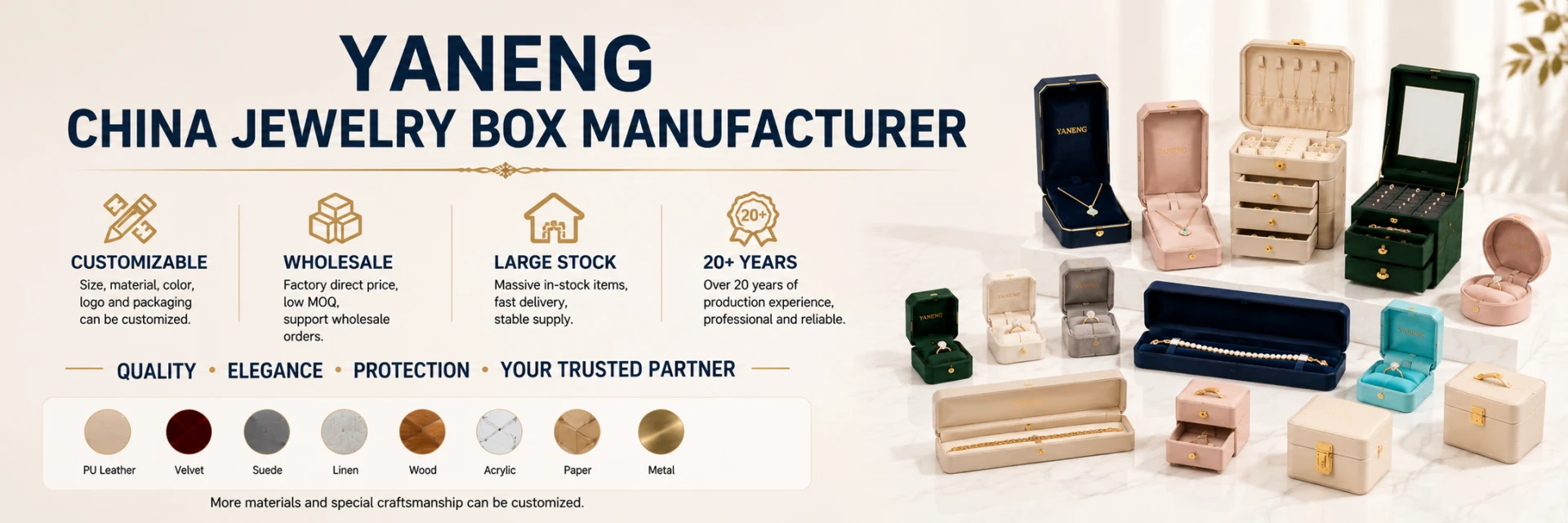
Guangzhou Yaneng Packaging Co., Ltd. is a China-based packaging manufacturer established in 2005. With approximately 5,000 square meters of factory space in Guangzhou and a production facility in Yiwu, Yaneng provides customized packaging solutions for overseas wholesalers, brands, retailers, and trading companies.
Our product range includes rigid gift boxes, magnetic gift boxes, drawer gift boxes, lid and base boxes, custom paper gift boxes, jewelry boxes, and related packaging products.
For custom gift box projects, Yaneng supports buyers through several stages:
- Design support: Discuss box structures, dimensions, materials, and logo requirements.
- Material selection: Help buyers select suitable paper, rigid board, lining, and accessories.
- Sample development: Prepare samples for buyers to evaluate before bulk production. Sample timing depends on project complexity and material availability.
- Customization: Support OEM and ODM packaging projects with customized structures and branding.
- Production and inspection: Arrange production according to approved specifications and apply quality inspection procedures.
- Order coordination: Communicate production progress, packing requirements, and delivery arrangements.
We understand that wholesale buyers need consistent packaging quality, competitive pricing, and dependable production planning.
Our goal is to help customers develop gift boxes that meet their product requirements while supporting repeat orders and long-term business cooperation.
If you are comparing custom gift box manufacturers in China, you can send Yaneng your design, reference photos, dimensions, materials, and estimated quantity. Our team can review your requirements and help you evaluate a suitable packaging solution.
Conclusion
Comparing custom gift box samples before bulk ordering is an important step in reducing purchasing risks.
Buyers should evaluate more than the overall appearance. Material quality, board strength, printing accuracy, structural performance, corner finishing, product fit, and supplier consistency all affect the final result.
The best sample is not necessarily the cheapest or the most decorative. It is the one that meets your product requirements, matches your brand image, and can be reproduced consistently during mass production.
Before placing a wholesale order, prepare the same specifications for every supplier, inspect each sample carefully, compare complete quotations, and approve the final design in writing.
Looking for a reliable custom gift box manufacturer in China? Contactar Yaneng Packaging to discuss your project, request sample support, and get a quotation for your wholesale gift box order.